
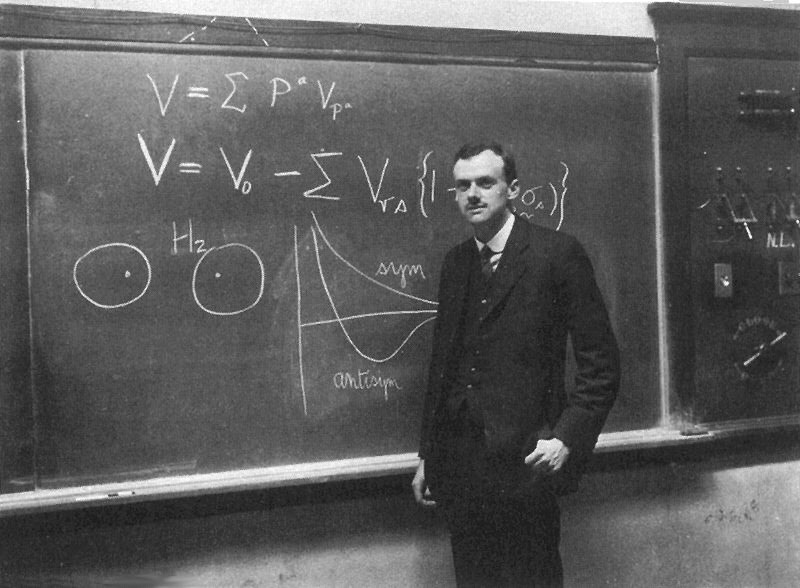

In 1928, British physicist Paul Dirac wrote down an equation that combined quantum theory and special relativity to describe the behaviour of an electron moving at a relativistic speed.
The equation – which won Dirac the Nobel Prize in 1933 – posed a problem: just as the equation x2 = 4 can have two possible solutions (x = 2 or x = −2), Dirac's equation could have two solutions, one for an electron with positive energy, and one for a particle with negative energy. But classical physics (and common sense) dictated that the energy of a particle must always be a positive number.
Physicists interpreted this new particle as an “anti-electron”, a particle with a mass identical to the electron but with opposite electrical charge. The existence of this particle was demonstrated with Carl Anderson’s discovery of the positron in 1932.
Today we know that every type of matter particle has a corresponding antiparticle with matching properties, except for opposite electrical charge. This symmetry has two consequences: particles and antiparticles are always produced in pairs, and they annihilate upon contact, leaving only energy behind, predominantly in the form of photons and pions.
The matter-antimatter asymmetry problem
According to our understanding, during the first fractions of a second after the Big Bang, the hot, dense universe was filled with pairs of particles and antiparticles popping in and out of existence. But if matter and antimatter are always created and destroyed together, then today's universe should be filled with equal amounts of both. Alternatively, it should contain nothing but leftover radiation from the annihilation of all the matter and all the antimatter produced in the Big Bang.
However, what we observe is neither of the above. The Universe is clearly not empty, yet the 50% of antimatter is nowhere to be found. In fact, the Universe appears to contain almost no antimatter whatsoever. The current best explanation for this is that after the Big Bang some unknown mechanism created a tiny excess of matter – approximately one extra particle per billion antiparticles. When all the matter and antimatter annihilated, this excess is all that remained. This forms everything that we see today, from the smallest life forms on Earth to the largest stellar objects.
One of the greatest challenges in physics today is figuring out what happened to the antimatter and understanding the source of the observed asymmetry between matter and antimatter.
To answer this and other questions, physicists at CERN make antimatter for study in experiments. The starting point is the Antiproton Decelerator, which slows down antiprotons so that physicists can investigate their properties with very high precision.
Frequently asked questions
AEGIS, ALPHA, part of ASACUSA, and GBAR study fundamental properties of antihydrogen to test matter–antimatter symmetry and the weak equivalence principle, using plasma traps, atom traps, atomic beams, and high-resolution laser spectroscopy. ALPHA has measured antihydrogen properties to 12 significant digits. ASACUSA additionally studies antiprotonic atoms to determine the antiproton–electron mass ratio. BASE uses cryogenic Penning traps to compare proton and antiproton properties; its 11-digit charge-to-mass comparison is the most precise baryonic matter–antimatter test. PUMA will use antiprotons to probe neutron-rich nuclei.
Electrically charged antiparticles
It is possible to contain electrically charged antimatter particles such as antiprotons by using electromagnetic traps that confine the particles within a magnetic field, preventing them from annihilating with other particles. However, particles of the same charge repel each other, so the more particles there are in a trap, the larger the trap has to be and the more energy is needed to power the electric and magnetic fields that contain the antiparticles. The biggest current traps, such as those in the GBAR and PUMA experiments, can contain up to approximately a billion anti-particles of the same charge, which in everyday terms is equivalent to about 10-18 kilograms (0.000000000000000001 kg).
Electrically neutral antiparticles
For electrically neutral antiparticles or anti-atoms like antihydrogen, the situation is even more complicated. It’s not impossible however: antihydrogen atoms are slightly magnetic and can be trapped in a very strong and specially shaped magnetic field, first demonstrated by the ALPHA experiment at the antimatter factory. They can be stored for many hours, allowing physicists to perform precise studies of their properties. In principle up to 100 000 particles could be stored this way with the current technology.
Even if we could somehow construct a trap that could hold large quantities of antihydrogen without losses and run the CERN Antimatter Factory non-stop for a year, we would only accumulate about 30 million atoms, equivalent to 3*10-20 kilograms (0.00000000000000000003 kg). The total number of antiprotons delivered would be 300 billion, which is still only 3*10-16 kilograms.
If we were somehow capable of producing and trapping large quantities of antimatter, large-scale annihilation could theoretically be used to produce energy. But, using the antimatter as an energy source would be very difficult since it would be challenging to convert the high energy pions and gamma radiation produced in the annihilation into a usable form of energy.
Be that as it may, we are currently incapable of producing any significant quantity of antimatter (see previous answer). The maximum amount of antihydrogen that we imagine making in one year, even if we could trap it all and make it annihilate all at once, would produce a few thousandths of a Joule of energy. This is equivalent to the amount of energy released by gently tapping a phone screen with a finger.
All the antiprotons produced by the Antimatter Factory running non-stop throughout a whole year would equate to about 500 Joules of energy, enough to light a 100 W light bulb for five seconds.