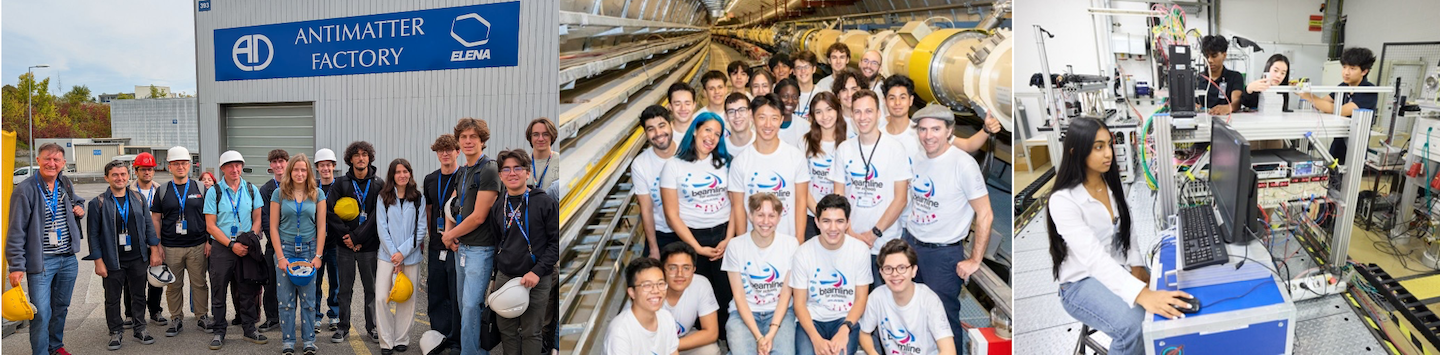
For its 2026 edition, Beamline for Schools (BL4S) has received 712 submissions, involving 4051 students from 89 countries, the highest number of applications since its creation in 2014. This represents a 40% increase compared to the 2025 edition and the highest ever number of countries participating. Since the launch of the competition, more than 28 000 students have submitted research proposals. The selection process is ongoing, and the winning teams will be announced in May, so stay tuned!
Beamline for Schools is an education and outreach project, funded by the CERN & Society Foundation, that started in 2014 in the context of CERN’s 60th anniversary. Multiple teams of high-school students propose an experiment to be performed on a beamline at CERN, DESY or ELSA (University of Bonn) – an experience designed to inspire the scientists of tomorrow to pursue careers in STEM (science, technology, engineering and mathematics). The winning teams have the opportunity to run their experiment like true physicists, immersed in a cutting-edge physics environment in one of the three laboratories.
“High-school students are very creative, and the proposed experiments grow each year in complexity, creativity and technicality”, says Jorge Villa, school and students programmes manager at CERN. Previous winners have explored a wide range of scientific topics, from the development of two-dimensional detectors and three-dimensional muon detectors using scintillator encoding, to the use of Silicon Photomultiplier (SiPM)-on-tile muon calorimeters for high-altitude applications and multi-wire proportional chambers. Some teams have worked on beam diagnostics in CERN’s East Area, leading to remarkable results. Experiments related to particle beam interactions and radiation studies like spallation and? transition radiation in multi-layered dielectric–metallic targets have also been carried out. “We regularly review and update the pool of detectors available to the students, to give them the best tools for their experiments. Right now, we are working on integrating MicroMegas and Timepix detectors into our experimental setup”, says Markus Joos, BL4S technical coordinator at CERN. The competition has led to scientific publications, educational publications and contributions in international conferences and workshops (see here).
This competition is only possible thanks to the many volunteers at CERN, DESY and ELSA. A huge thanks to all of them!
|
Join the BL4S team! 
Members of the CERN community are more than welcome to join the Beamline for Schools team. BL4S exists thanks to the many volunteers who help throughout the year in many ways, such as reviewing the proposals to select the winning teams (in March 2026, 40 volunteers contributed to the review of 712 proposals), taking part in online events to present their research and experiments to the students, helping with data analysis when the winning teams are at CERN or acting as regional contacts for students of the same native language. For the 2026 edition, additional support will be required in August for data analysis activities and after the summer for online events and national contact activities. Go to cern.ch/bl4s to find out more. For more information about volunteering, subscribe to bl4s-volunteers-pool. You can also send an email to beamline.4.schools@cern.ch, and we will be happy to get back to you to discuss the different volunteering options. With the increasing number of proposals, we will need more volunteers, in particular to evaluate the proposed experiments and select the winning teams. Come and join us – be part of an amazing initiative that has a worldwide impact on the education of high-school students. |